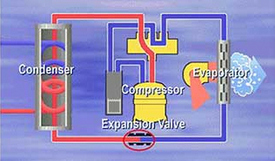
How It Works: Anatomy of a Geothermal Heat Pump
You already have a heat pump in your
home - your refrigerator. If you put your hand behind it, you'll feel the heat
that's being pumped from the inside. A geothermal heat pump works much the same way
It's the same principle that a geothermal heat pump uses to warm your home.
Instead of producing heat like a conventional furnace, a geothermal heat pump moves heat from one place to another - from the ground into your home.
Geothermal Heating and Cooling
Geothermal cooling process
The diagram above illustrates the summer geothermal cooling process:
In short, the indoor coil and underground piping cause the refrigerant to change state, absorbing and releasing heat through boiling and condensing. The compressor and expansion valve move the refrigerant through the system by changing the pressure.
Need more information on Geothermal heating and cooling…
Geothermal is a natural way to tap into the earth’s natural energy to efficiently and economically heat and cool your home. For more information on geothermal heating and cooling contact the experienced geothermal experts at K. Kelly at 920-469-3500 to get all your geothermal questions answered.
Back to Geothermal
It's the same principle that a geothermal heat pump uses to warm your home.
Instead of producing heat like a conventional furnace, a geothermal heat pump moves heat from one place to another - from the ground into your home.
Geothermal Heating and Cooling
Geothermal cooling process
The diagram above illustrates the summer geothermal cooling process:
- The cool, liquid refrigerant enters the indoor coil during cooling. As it enters the coil, the temperature of the refrigerant is between 40 and 50 degrees. Anatomy of a Heat Pump.
- As warm, moist room air passes over the cool coil, the refrigerant inside absorbs the heat.
- The new cooler, drier air is circulated back into the room with a blower fan.
- The refrigerant moves into the compressor, which is a pump that raises the pressure so it will move through the system. The increased pressure from the compressor causes the refrigerant to heat to roughly 120 to 140 degrees.
- The hot vapor now moves into contact with the condenser (the underground loops), where the refrigerant gives up its heat to the cooler ground loop, then condenses back into a liquid.
- As the refrigerant leaves the compressor, it's still under high pressure. It reaches the expansion valve, where the pressure is reduced.
- The cycle is complete as the cool, liquid refrigerant re-enters the evaporator to pick up room heat.
In short, the indoor coil and underground piping cause the refrigerant to change state, absorbing and releasing heat through boiling and condensing. The compressor and expansion valve move the refrigerant through the system by changing the pressure.
Need more information on Geothermal heating and cooling…
Geothermal is a natural way to tap into the earth’s natural energy to efficiently and economically heat and cool your home. For more information on geothermal heating and cooling contact the experienced geothermal experts at K. Kelly at 920-469-3500 to get all your geothermal questions answered.
Back to Geothermal